 |
 |
|
|||||||||



 |
|||||||||||||||||||||
2013 Peregrine Nestbox News
Nestbox News is an account of activity at a nestbox atop Mack-Cali Realty Corporation's 101 Hudson, Jersey City, by biologists in the Endangered and Nongame Species Program (ENSP). Follow this chronicle of the nesting behavior and activity of peregrine falcons and their chicks. We encourage viewers to help support the webcam and all the work of the ENSP through the Income Tax Check-off for Wildlife and Conserve Wildlife License Plates. We appreciate and value your support, as well as the support we've received from the Conserve Wildlife Foundation of NJ and the Mack-Cali Realty Corporation and its staff at 101 Hudson - without their cooperation the nestbox and webcam would not be possible.
July 30, 2013
"Upon arrival, I spotted the adult female on the 39th floor ledge, north side of 101 Hudson. I went to the benches on the corner of Columbus & Hudson, and about a half hour later saw the adult male fly in from the direction of 10 Exchange Place and land on 101 Hudson. He landed on the same floor as the adult female, but on a ledge at the northeast corner of the building. "I waited until about 9:30 a.m. for any flights, then went out onto the pier for wide-angle viewing. Around 10:54 a.m., as I looked down briefly to check my phone, I almost missed the adult male fly over 10 Exchange and head back to 101 Hudson (one of the rules of falcon watching: take your eyes off the sky even briefly, and you almost always miss something!). I went back to the benches, and now he was on the same ledge as the adult female (though she had moved over a few parapets from earlier). "Around 11:50 a.m., after watching the adults preening and generally looking content, I decided to take a walk south along the river walkway, then headed back north up Hudson St. By the time I got up to York St. (almost in front of 101 Hudson) around 12:10 p.m., the adult female appeared high above. I watched her do slow circles and figure-8s in the brisk southerly wind, and admired how this species can effortlessly drift around as if there's no wind at all. She slowly passed overhead, and glided south over Hudson St., turning slightly east and disappearing over the row of lower buildings. I headed back out to the river walkway to try and re-sight her, but no luck. I milled around the area for a bit longer, then headed back to the car (a quick check of 101 Hudson along the way showed the adult male had departed as well)." Mike added some photos from his visit to his Flickr gallery for this month. A big thanks to Mike for keeping us informed of activity in Jersey City!
July 23, 2013 - The Latest From Jersey City
"I walked out on the pier upon arrival, and about 15 minutes later, the fledgling and one of the adults came flying in high from the north (adult in front, fledgling trailing and screaming). Both flew over the river walkway toward the big office tower at the end of Hudson St. The adult whipped around the east and south side of the tower in a partial dive, and the fledgling went around the west and south side, then briefly appeared on the southeast corner as he landed on an upper ledge. "I decided to get up and walk down to the south side of the tower for a closer look, and heard the fledgling a few times on the way. There's not much space for viewing on the south side of the tower, and the angle is very steep. The ledges on this tower aren't very deep, but deep enough for a falcon to remain hidden from below. One of the adults was soaring over the top of the tower, and briefly perched on a southeast corner ledge near the top before taking off again. "I had snapped 2 pics of the fledgling while he was flying over the walkway earlier, and it looked like he might've been carrying prey! The soaring adult was probably making sure he still had it. Afterward, I walked back up to the pier for easier viewing, but didn't see further action. "Over the next couple of hours, I changed viewing spots a few times, but all was quiet. By 11:30 I decided to slowly make my way back to the car, but stopped at the benches on the corner of Hudson & Columbus to scan the north side of 101 Hudson. Found both adults perched on the 39th floor ledge, tucked next to parapets & staying in the shade (although it wasn't in the 90s, it was still quite hot in the sun). Since they were both there, I figured that during one of my walks to change location, the fledgling likely flew back north and was in the area somewhere (probably also seeking shade). There were 1 or 2 occasions when I thought I heard him, but didn't spot him." Mike again is making his latest photos available, adding them to the end of last week's gallery on Flickr.
July 16, 2013 - Update From the Streets of Jersey City
"Around 9 a.m., the adult female flew in from the northwest, and landed on a 39th floor parapet on the NW corner of 101 Hudson. After waiting a few minutes to see if additional flight action would happen, I started walking east along Columbus Ave, intending to go out to the waterfront for the wide-angle view. I stopped at Hudson St., and chose instead to walk south along Hudson St. and check the ledges on the low buildings that line the east side of the road (the falcons have made use of those the last 2 years). "I reached the corner of York & Hudson around 9:10 a.m., and got a brief look at a falcon making quick circles over one of the low buildings. When it re-appeared, I saw that it was the adult male. Shortly afterward, I heard the male fledgling calling out, and he soon appeared gliding over the buildings! Over the next few minutes, the adult and fledgling soared directly overhead, with the fledgling vocal the whole time (although he appeared to be carrying a small prey item; perhaps the adult had delivered it to him just prior to my arrival). The fledgling quickly gained altitude, aided by the southwesterly winds (ushering in our next heat wave) creating updrafts along the buildings. He ended up somewhere on the north side of 101 Hudson, but out of view from the street. Both adults had snuck away as well. "Between 9:45 and 10 a.m. the fledgling made a few loops around the top of 101 Hudson. Afterward, he apparently found a shady spot on one of the terraces on the west side of the building. I headed out to the Grundy Park pier for awhile, and had an unconfirmed sighting of the fledgling at 10:48 a.m., this time flying south over Hudson St. and disappearing over the low buildings again. A search of the area turned up empty ledges, so he might've found a shady spot on a roof. "Activity shut down after this, and with the exit of clouds and the temperature quickly heading for 90, I left at 11:35 a.m. "I got the sense that I arrived at the end of a more active period, but it was still a thrill seeing the fledgling in flight (especially at low altitude: great view)!" We thank Mike for providing this report - it's good to know the fledgling appears in good health and on its way to surviving its first year. Mike was also good enough to put together a photo gallery on Flickr for everyone's enjoyment.
July 11, 2013 - Webcam Shutdown
June 26, 2013 - Views From the Street
We are very grateful for such reports - as anyone who has checked the webcam the past few days knows, there is rarely a bird on camera at this point. Because of this we will be shutting the system down for the season to keep our costs as low as possible. Anyone wishing to donate to support the webcam and the work of the Endangered and Nongame Species Program can do so at www.ConserveWildlifeNJ.org/getinvolved/donate/ - the webcam would not be possible without such support.
June 21, 2013 - First Flights
We'll do our best to keep the camera on the birds, but as the chick continues to improve its flying skills it will expand the area it uses, and be less likely to be in the vicinity of the nestbox for long periods. But we'll keep watching. (For additional photos from yesterday visit Mike's Flickr page.)
June 18, 2013, 8:30 p.m. - An Adventurous Soul
Our fledgling was definitely feeling the north wind after the rain stopped for a few minutes. Perched atop the parapet wall over the nest box, he spread his wings and felt the wind through his feathers. He flapped, then flapped some more, and lifted off. An inch or two, then more, lifting off the ledge with legs hanging! He kept at it for 10-15 minutes, flapping, jumping, and several times lifting off and hovering in place above the wall. We can only imagine the feeling of being raised by the wind. (For those who are older, we might recall the opening scene of "The Flying Nun," angling into the wind and being raised up!) Fledgling 44 was joined in the corner by mom, who seemed to be enticing him to join her in the sky by taking brief flights in front of him. She finally jumped down to the roof below, leaving him to perch and run along the ledge, looking down (presumably) toward her. This seemed like a lot of activity after an afternoon of heavy rains; perhaps they all had some pent-up energy to release!
June 15, 2013 - 9:00 p.m. Update
We'll log in again in the morning to hopefully stream some activity on the rooftop.
June 15, 2013 - Out Of the Box!
At the age of about 38 days, this youngster is still about half a week away from being capable of flying, so we hope he will continue to strengthen his flight muscles by running and flapping around the roof. All that exercise will prepare him for successful flight. He has the full attention of his two parents, which is a real plus; they will be watching him (and feeding him) wherever he goes. This is an exciting time for new fledglings as they learn so much in a very short time. We hope to keep seeing him on the webcam, but the camera's view is limited, so we'll have to settle for some interesting views as they occur. But from his time on the ledge today, we're sure he is ready for adventure!
June 6, 2013 - Banding Day
(Updated 6:00 p.m.)
As our webcam and Nestbox News followers know, this nestling is a foster chick biologists swapped in to replace the sickly chick hatched on May 14, the only one of four eggs to hatch. The original chick was evaluated at The Raptor Trust and euthanized due to its poor condition. The "new" Jersey City chick is a Sea Isle City native, one of four hatched around May 9, and by the looks of things, has been enjoying having the full attention of two doting foster parents! At yesterday's banding, he was found to be in excellent condition, but was given a dose of medication to prevent Trichomoniasis, a pigeon-borne disease. This youngster a male, and he was banded with federal band 2206-75866 and color band "44/AM." We'll call him "44" for short. Those viewing the webcam during the banding operation could see how the birds protect their nest by diving at and even punching the umbrella protecting the biologists. While the chick was indoors the adults stood vigil, perched near the nestbox. The adult female's origins remain unknown, as she is banded with only a federal band whose number cannot be read from a distance, and she never slows down enough for a good look. But we know she's been the same female since approximately 2002 when she would have been at least three years old to begin nesting. The adult male was banded ten years ago as a chick at Riverside Church in New York, which we know from his color band 2/6. He has been resident here since 2006. (The male first appeared in the August 22, 2003 Nestbox News entry when, as an immature bird, it landed and was photographed on an apartment terrace in Edgewater!) The information gained from banding birds is very valuable: we learn about their survival rates, longevity, age at breeding, and distances (and locations) traveled in migration. Falcons banded as chicks in Jersey City have been resighted elsewhere, nesting in nearby Elizabeth (notably, the Union County court house), and in Binghamton, Brooklyn and NYC, and one on a cliff in New Haven, CT. WCC volunteers Bonnie Talluto and Mike Girone also were there to assist, and both have graciously offered the public to view their photos from the banding via Mike's on Flicker at http://www.flickr.com/photos/80696806@N06/sets/72157633970889283/. The next milestone will be the first attempts at flight, anticipated in another two to three weeks. However, it's likely the youngster will soon make his move to leave the nest box - once on the roof he will have a lot of space to run and flap - necessary exercise prior to that all-important first flight. Keep watching!
June 4, 2013 - Banding Day Arrives!
Time and conditions permitting, they'll also do a hasty repair on the PVC conduit carrying the signal from the nestbox camera; we believe it was damaged during Superstorm Sandy. The camera view will be adjusted so we all can watch the rooftop action as the adults protect their territory from our well-meaning biologists. We'll report on our findings on this page as soon as possible.
May 29, 2013 - Plenty to Eat!
May 24, 2013 - Feeding and Growing
The foster chick from the Sea Isle City nest is thriving as the sole focus of the adults' attention and care. Unlike the lone hatchling from the pair's clutch of four eggs, this chick is feeding enthusiastically, moving about and behaving normally. Sadly, despite the efforts of staff at The Raptor Trust, the Jersey City chick was humanely euthanized due to its abnormalities, both physical and behavioral. We hope to determine its exact problem(s) post mortem.
During the first week of June biologist will return to Jersey City for the annual chick banding - see the 2009 banding PDF (800kb) or PowerPoint version (18.5mb) for an overview of the procedure. We'll report back then, and sooner if anything noteworthy occurs. Meantime, assume no news is good news - and enjoy your peregrine viewing!
May 20, 2013 - Morning Update
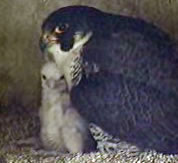
Hopefully the drama of the past week is behind us as we watch the new chick grow. We'll determine its sex the first week of June when biologists return to Jersey City to examine and band it. Meanwhile, we'll keep watching. For more photos from Jersey City the day of the swap, visit Bird Cams Around the World. Thanks to Bonnie for the photo of the female and new chick to the right.
The chick is now en route to The Raptor Trust for examination and care. We'll update this page later tonight or tomorrow morning, but viewers will know about as much as we do for now.
May 17, 2013, 8:00 a.m. - A Plan Is Formulated
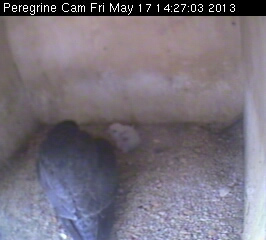
In the nest on Thursday, the chick was not sitting up, which is necessary for it to be fed. It had gotten fed each day, but on Thursday the chick seemed worse, spending most of its time lying down and even apparently stuck on its back. This is not normal for a chick that is two days old. The other three eggs have not hatched and we don't expect them to hatch at this point. The adults are still trying to incubate them, which is also distracting them from the chick. We may be seeing the lower nest success that is characteristic of older peregrine falcons. While our female remains an excellent caregiver, her eggs have lower viability, and the chick may suffer from a genetic abnormality. The eggs could also be carrying accumulated toxins that are interfering with hatching and normal chick development. In the interest of keeping this pair active at the nest site, we will be providing them with a foster chick this afternoon that we're transferring from a four-chick nest in Sea Isle City. Biologist Mick Valent will put the chick in and remove the eggs and the sick hatchling. He will deliver the hatchling to The Raptor Trust, where we hope to get a clue as to what is wrong. The eggs will be valuable samples for future analysis. Fostering chicks into nests is a proven technique and we fully expect the Jersey City adults will quickly adopt the new nestling. By doing this, we will allow the birds to fulfill their nesting cycle, giving full attention to raising one chick. The donor nest also benefits, because the adults will have a little less work raising their three remaining chicks. At both sites, we raise the chances of ultimate survival for all the young.
May 16, 2013, 1:30 p.m. - Problem In the Nest
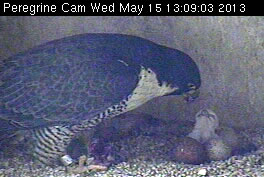
It could be any number of reasons, or combination of reasons, that this situation is what we're observing. Unfortnately, there is no action we can take to help the chick at this time, and to so would likely be futile in the end. Meanwhile, the female continues to incubate the three eggs which are almost certainly beyond the point of hatching. A visit to administer medication early next week may have a different purpose if things do not turn around soon. But we'll be watching.
May 6, 2013 - Video is LIVE!
We are excited to share with you the live view atop 101 Hudson Street in Jersey City. The peregrines have been diligently incubating their four eggs since April 11th, and we are looking forward to hatching next Monday or Tuesday. The streaming video is much more interesting to watch than the still pictures (which have been available since early April), and the action during and after hatching makes viewing fascinating and addictive for most of us! The problems of this past month are a combination of old equipment (some of it in place since 2001), outdated software, and the restrictions of the state website. We are hoping that with viewer contributions, our partner, the Conserve Wildlife Foundation of NJ, will be able to replace the system with a new digital one, and make the webcam available via an independent provider. We hope you'll consider partnering on this: watch for the Peregrine Webcam Campaign on the CWF website in the coming weeks. And thank you!! Now...go enjoy the Live Peregrine Webcam!
Without the streaming video available, and relying only on still images, viewers can see that most of the incubation is by the larger female. The male has been seen sitting nearby, but most often is out of camera range. He has the most responsibility for catching and delivering prey, while she will do most of the incubating; but the eggs are never left unattended for more than a couple minutes. We are still working on getting the streaming video running and hope to have that available soon!
April 8, 2013 - A Third Egg
Incubation won't begin in earnest until the female has finished the clutch. Last year five eggs were laid - an indication the female is getting to be an older bird. We'll continue monitoring the nestbox, as we hope you are as well!
March 14, 2013 - Another Season Begins
As far as the activity at 101 Hudson Street, we are assuming the 2013 nesting season is already under way. Unfortunately, due to budgetary constraints we have not yet activated the cameras but hope to be streaming video and still images before egg laying begins later this month. We are sure this will be another exciting year observing the peregrine falcons using the nestbox maintained by the NJDEP Division of Fish and Wildlife's Endangered and Nongame Species Program. The first nestbox was installed in 2001 and has fostered the successful fledging of young every year since (see About the Peregrine Project for a history of the project). Last year was a difficult year, with only one of three fledglings known to have survived through the summer after the hatching of three eggs from a clutch of five. (See the 2012 Nestbox News for details.) We do want to remind the viewing public that funding for projects such as this remains hard to obtain - the Peregrine Project, like other projects conducted by the ENSP, is funded entirely by grants and donations. Please help this project continue by making a direct donation to the ENSP, or by "checking-off" for wildlife on your state income tax return. By becoming a partner in the work of ENSP you can proudly feel you are doing your part in protecting our endangered and threatened species. We hope you enjoy following the Jersey City peregrines this season; it's sure to be as exciting as it has been in past years. |
|||||||||||||||||||||
|
|||||||||||||||||||||
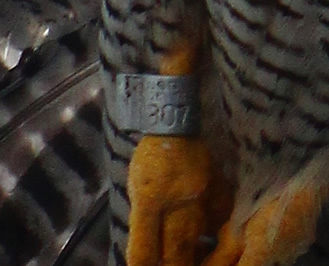 On banding day Mike managed to get some photos of the legbands on the female, enabling us to get a look at some of the identifying numbers. At this point we're still investigating, but indications are that she may be an 18 year-old female hacked near Maiden Creek, PA in 1995. That age makes sense in terms of how long she's been in Jersey City, the large egg clutch, the failure of eggs to hatch and the and the damaged chicks we've seen the past few years. However, a missing color band makes a positive ID at this point impossible.

 Unhealthy offspring and other obstacles to healthy populations of wildlife occur in nature - it's part of the scheme of things. With endangered wildlife, such as our New Jersey peregrines, biologists may intervene when possible in the interest of helping a species recover. Fortunately, circumstances allowed us to perform last week's "
 May 17, 2013, 2:40 p.m. - Mission Accomplished!
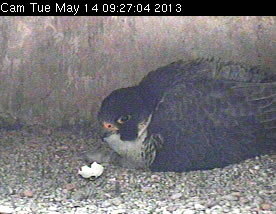
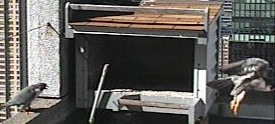 April 18, 2013 - Incubation quiet time
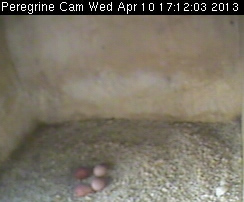 April 11, 2013 - Four Eggs: A Complete Clutch?
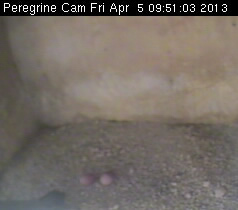

|
||

|
||
 Some
files on this site require adobe acrobat pdf reader to view.
Some
files on this site require adobe acrobat pdf reader to view.
|
||
|
|
||